Showing posts with label fandom. Show all posts

Tuesday, 17 November 2015

Why the Doctor Can't Be a Woman


I've been re-watching episodes of Doctor Who from season 4 onwards while I wait out the plague.  There are things about each Doctor that puts a pleasant little squeeze on my heart: the way Nine says "fantastic" in his Manchester accent, Ten's openmouthed exclamations, and Eleven's arm-flapping and slurring, soulful speeches--Smith is arguably the best NuWho Doctor, his range is amazing and original--and that's one of the things that makes this show immortal.

There's always going to be feet-dragging from the audience in response to change of any kind, but its the flexibility inherent in the character and his casting that allow Doctor Who to go on and on.  When one storyline becomes stale, one version of the Doctor grows unsympathetic, or the themes sway in significance, all that can change.  Doctor Who demonstrates survival of the fittest for television series!

There is one thing, however, I firmly believe will never come to pass in the Whoniverse.  The Doctor cannot be a woman.

David Tennant's sideburn's tumblr, haha.

This is where I'd popularly bemoan the inherent misogynism of All Things and rant about the fact that our civilization could never accept a woman as the Cleverest Person in the Universe.  But I won't, and not because I recoil from the idea of a powerful, intelligent, and commanding female.  I was as put out as the next self-respecting woman when the writers put in that bit about "an enigma squeezed into a mystery squeezed into a skirt that's just a little bit too tight" comment.  (Incidentally, I was really unnerved at Amy Pond's kissing assault on him, so that I never really forgave her or liked her after that.)

The reasons why the Doctor will never be a woman, as long as it is necessary to pique the interest of human nature, is because women are different from men and men are different from women; and men and women are more different from each other than different races, different heights, ethnic groups, or hair colors, etc.  To change the gender of the doctor would be to distort the character of the Doctor beyond recognition.  It would be like making the Doctor an Ood or Sontaran or a dog.  Not gonna happen.

Think about the current controversy surrounding transgenderism.  It's no light thing, no matter from what point-of-view.  Trans-folks will attest to the fact that gender is far from irrelevant but a deeply psychological, soul-defining fact.  Not a trait.  A state of being.  I don't think I speak out of turn here when I say that for trans-people, gender reassignment isn't a mere makeover.  It's a becoming of themselves.


It's not possible to flippantly change the Doctor's gender, even if the possibility of it is, for all intents and purposes, canon in the Doctor Who universe.

A change like that would be monumental and irrevocable in its reimagining of the beloved character: either the Doctor was a woman in a man's body the whole time or he is a man in a woman's body now.  Problems abound.  And even though that could be used as a very enticing and thought-provoking story premise, there is no room for such a fundamental paradigm shift in the focus of the series without completely unmaking it.  It's not in the nature of Doctor Who to go down that path.  If it did, it would unravel into something much more mature and sinister (which is one of the reasons for the Torchwood spinoff).

The nature of identity in DW has been experimented with before with secondary characters: interspecies relationships between cats-and-humans and lizards-and-humans, for example.  Jack Harkness was immortal and pansexual.  The latest plot with Master/Missy is one step away from a gender-swapping Doctor.  And while it is necessary for the survival of a series for the main character to evolve, to change, to grow, to fall back, to pick himself up again, to fail, and to renew his commitment to Being a Force for Good, it is completely impossible for the main character to cease being himself.

I believe that is what a change of gender for the Doctor will do.  Either the Doctor before the change or the Doctor after the change will be made false.  They can't both be true.  And when the Doctor is false, he is not real to the audience, and there is no Doctor for us to care about.

∆∆∆

This is how I've thought it through so far, but I'm always likely to miss something.  Change my mind!  What do you think?  Can the Doctor ever be a woman without setting up the show for failure?

Friday, 10 July 2015

#7QT: Reading, Writing, and Drawing


-- one --


Everybody not going to Edel, stand up and say "hey-oh!"

That's it?  Really?!

As for the rest of you, OMG, have fun for us!  I'm so jealous.  Charleston!  (Any other Southern Charmed fans out there?)

-- two --


We finished listening to {Little House on the Prairie} and are now on to {The Sword in the Stone}.  This is a mad favorite of mine, since I am an Arthurian enthusiast.  But it stands on its own as a pristine piece of literature for the ages.

I'm not going to be homeschooling any time soon, at least not Afon, but this book would be ideal as both a model and a tool for home education.  "Eduction is experience, and the essence of experience is self-reliance" says Merlin.  Wow.  Just think about that for a minute.

And White's knowledge of natural sciences is so thorough and the opposite of boring.  I mean, I liked Biology in high school, but man, if Merlin were teaching it, I might not have gone on the English major track after all, that's how good it is!

White's insights as an Arthurian scholar are really profound as well.  And if you like folklore and fairy tales, you'll not get a better explanation of what fairies are than out of the mouth of Robin Wood in The Sword in the Stone.

This was my professor's copy of Malory when he was in school at Oxford.  It's one of my most prized possessions!

-- three --


I hope that if you are here, you know Tolkien wrote much, much more than the stories of Middle Earth, though no little can be said for the masterpiece that is The Lord of the Rings.  But did you know he was also a talented illustrator?

I've found that people were much better at drawing before the age of television and modern entertainments.  I think it was just natural for the childhood era of drawing to extend further into adolescence and beyond because there weren't as many distractions.  I'm just conjecturing here.  But I've been fond of Tolkein's illustrations ever since purchasing a book that document some of the letters from Father Christmas he wrote for his children.

Now this new book is out with new-to-me pictures that are really fascinating; they remind me of Blake's etchings, and that seems fitting, somehow.  You can read up on {Tolkien: Artist and Illustrator} {here}.

-- four --


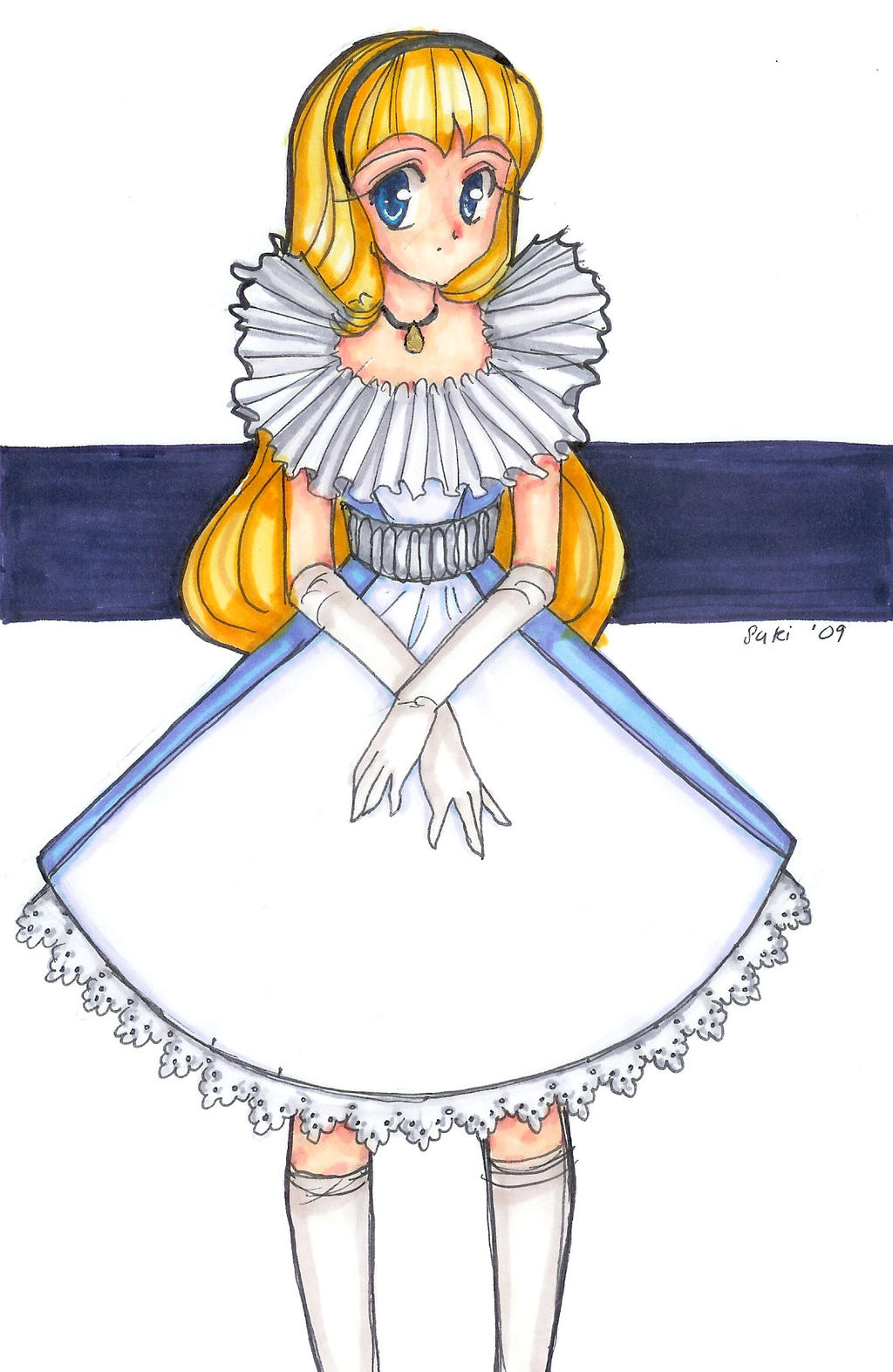
It makes me want to start carrying a sketchbook with me everywhere.  I did it in Rome, along with my camera, and now I have a beautiful record of my four months in the Eternal City.  I'm not a great artist, but I'm very fond of the Pre-Raphaelite school and of modern Japanese manga style.

It's my own take on Alice, in Wonderland!  (Suki is my pseudonym for anything fandom.)

-- five --


It's just one more thing that needs prioritization.  While I have small children, blogging is a great channel for creativity because there is no physical product that Afon can tear up and therefore has to be carefully minded and put away out of reach.  Even when I did draw, I was terrible at filing and organization.  I usually just kept all my most recent pictures in a grubby pile by my bed with my art things and then went through them when they got to be too numerous.  I hated when anyone moved or otherwise touched these piles, too, because then I wouldn't know where to find them!

-- six --


So it's probably crazy that I've got this little {Etsy shop} selling hand-lettered quote cards and prints, but I do so enjoy it!

-- seven --


A much speedier outlet is collecting bits of inspiration and things from what I've read and jotting them downing a notebook.  This is called a {commonplace book}, and this is mine:
It's a Moleskine, of course, and Afon helped make it very pretty with some pen marks of his own.  I'd like to get some sketchbook versions of these, too.  If anyone is interested, I'd be happy to custom make them some, and we can go round Etsy.

Joining Bonnie this week for {7 Quick Takes}.

Friday, 19 June 2015

7 Quick Takes


-- one --


As of today, it is Afon's third day of school, and I'm not entirely sure he's hated every minute of it.  But I do have to tell you, the break is nice.

-- two --

We were shopping late at Walgreens the other night, and guess what came on the radio?  That 90's song "Peaches" by The Presidents of the United States of America, followed by Florence and the Machine's "Dog Days."  It was, like, zen, ya'll.

Young folks, take a listen (the video is also great, watch it to the end!):


-- three --

Been putting this baby in his Bumbo:


Someone gave it to me before he was born, which was so sweet and helpful!  He'll only put up with it for so long, but I like that I my hands are free and he's still sort of engaged with me while I'm doing other things.

He doesn't like his Moby wrap because he likes to be able to look around when I'm wearing him, and the backpack is pretty impossible for me to take on and off without help, so I'm sort of in the market for a sling.  I think he'd like it.  I don't want to spend a lot of money and then find out that it's really hot, short, or uncomfortable, though.

Any suggestions?

Or maybe someone wanting to sell a used one in good condition?

-- four --

What I've been reading lately:
1 // Still--or perhaps a more accurate word would be paused--on The Cloister Walk by Kathleen Norris. 
2 // Afon and I read and finished The Magician's Nephew for his bedtime story.  He mostly talked/babbled through it or fell asleep, and in retrospect, I want to read the Chronicles in original publication order, but it was good to try out a chapter book with him. 
3 // Re-reading--or rather listening to--Mary Shelley's Frankenstein podcast on my iPhone during long drives.  It's neat hearing it versus reading it; and my second time around, I'm catching on a lot more to things that I missed when the material was all brand new.  Still one of my favorites!

-- five --

I found this in my Blog Photos folder just now.  Just playin' around with PicMonkey.
That was just using the makeup features, not the nip/tuck photoshop brushes.  Really makes you think about this airbrushed "improved" versions of celebrities and models in magazines and glad for publications like {Verily} who swear off the fake in favor of real beauty.

-- six --

Game of Thrones season finale?  I thought the penultimate episode was better.  Still, eager to see what happens.  I should probably foreswear the television show in favor of the books.

Also, dissatisfied about the death of You-Know-Who.  Isn't he, like, a main character?

-- seven --

If you haven't been around in a while or are new to the blog, here's what you missed:

Joining the indomitable Kelly for {Seven Quick Takes Friday}.

Friday, 22 May 2015

7 Quick Takes


-- one --

Blogging has been sparse lately because everything has descended and squeezed into the past couple'a twenty-four hours!  My husband flew in from Wales last Thursday evening; my childhood best friend arrived on Saturday; and I fit in a visit with a distant friend from New Hampshire.  And lots of other things in between, including naps.  :3


(I was treated to a pedicure as an early birthday present!)

We want to try to spend time together as a family while my husband is still here, so I don't know how frequently I'll be able to post.

-- two --

The URL for this blog is changing from www.lcricardo.com to www.everythingtosomeone.org!  Because it just makes more sense!

-- three --

So . . . the Mad Men finale exceeded above and beyond all expectations, amIright?  I am.  Can't wait to read {Christy's} and {Kathryn's} thoughts on it.  Or feel free to chit chat about it with me in the comments!

-- four --

The past two weeks, on Everything to Someone:


Check them out if you missed them!

-- five --

Before Mother's Day (gosh, where does the time go?) I went ahead and cannon bombed into the rebrand of my modest photography business.  When I spontaneously decided to open a {Facebook page} for it, I just asked the nearest person what I should call it.  Who happened to be my father.  But I didn't really get a chance to contemplate on what I wanted to do with my photography, what style I was aiming for, and my philosophy of art.

Around the time of opening my {Etsy shop}, one of the discarded names really captured my imagination, and so I worked it out so that I would incorporate it as a different brand:

Crown & Bough Photography!


I'm sssssuper happy with it; and a new business name calls for {a new website}.  Check it out for all the pretties!

-- six --

Reading:


  • Winnie-the-Pooh with my four-year-old.  It gets better every time you read it!
  • Got a few more pages read in The Cloister Walk by Kathleen Norris.

-- seven --


We had Afon's IEP (individualized education program) meeting at the school he will be attending in the fall.  It's so exciting!  They even have a special needs bus that will pick him up and drop him off.  August 24th can't come soon enough!

Joining Kelly at {This Ain't the Lyceum} for 7 Quick Takes Friday.

Saturday, 21 March 2015

Bored to Death

A Review of Disney's Maleficent


This review was {originally posted} on my fairy tale blog, {Spinning Straw into Gold}, on June 12, 2014. With the release of Cinderalla, I thought it appropriate to share it here, especially after {Haley's review} and {Kendra's adept comparison} of the two.  If you have some things to add about Maleficent, stay tuned, because a round table discussion on it is forthcoming on SSiG.

The first thing I do after watching a movie is to head over to Rotten Tomatoes to peruse the film reviews by proper critics.  The second thing I do, if it is a fairy tale movie, is to hit up all my fairy tale blog peeps for a more balanced perspective.  Sadly, my colleagues have been rather silent on the matter, with a few exceptions, so I suppose I ought to help get the ball rolling.

{source}
Before we go on, let us first note:  Here there be spoilers.

We've been hearing about Maleficent for years, but in the end my experience of the film can be summed up in one word: bored.  I don't know if I'm the best judge of entertainment, since I have a peculiar and finicky taste, but from the opening voice-over to the ending credits, I found little to hold my attention.  If it had not been for the pretty costuming and talented actresses, I might have lost interest entirely.  It was just all very tepid, underneath the fancy CG.  I didn't feel there was much at stake.  Maleficent lost her wings, and her love, but she was good and happy before she met Stefan and during his absence.  If she could walk into the castle to curse a baby, surely she could have retrieved her wings while she was at it.  Even the curse is tamed to a sleep-like death, without a desperate, last minute intervention from a good fairy.

"Mom, is that you?", {source}

The supporting characters are boiled down to their lowest common denominators, becoming tedious distractions rather than tools to help the story along.  Certainly not characters in their own rights, with complexities and inner goings-on.  

Stefan  is a kind of caricature born out of the necessity for a villain, and his motivation is weak.  The filmmakers need to give us a little bit more to work with if they want us to meet them in the middle; it's hard enough to believe that a kind boy, who would throw away his iron ring because it hurt a magical creature he only just met, would then become so heartlessly ambitious so as to turn around and try to kill the same creature, someone he cared for enough to have spent time growing up with her.

The pet raven is given a speaking voice by occasionally taking the form of a human but still doesn't have much to say.

In the end, Maleficent and Aurora alone are given room for growth and exploration, while the other characters and plot developments move around like props.  But even poor Aurora's character is charming and bland.  Her greatest moment is when she speaks out to the witch hiding in the shadows and does not recoil from her.  Not much of a monumental and memorable game-changer.

For me, the most engaging moment of the whole movie was when Maleficent stands over the sleeping Aurora and wills her curse undone, only to have it thrown back in her face.  And I credit all that to Ms. Jolie's powerful acting.  (Also done well in the moment she realizes her wings have been taken from her.  Maybe a tad melodramatic, but so wrenching and real that it made me hurt for her!)

{Adam of Fairy Tale Fandom} writes,

[Maleficent is] about two people and how their hearts become darkened by ambition, anger, bitterness and revenge. It’s also about how one of them starts to regain some light through exposure to someone who is good and innocent.

and I think he's absolutely right.  But I feel like the key relationship, between Maleficent and Aurora, is not given any time to develop, what between Maleficent watching her in her sleep and Aurora playing in the Moors with the magical creatures which are all show and no soul--the eeriness of Faerie is lost in this film, and I'd like to think I've cultivated a good radar for it.  In Brave, for instance, that otherworldliness remains intact.  It's hard for me to suspend disbelief and get behind Aurora's running away to the magical Moors forever, when it's just.  So.  Boring.

laughing and twirling and playing with magical creatures can only entertain me for so long
{source}

Besides that, there were a lot of other little frustrations.  How did the writers choose which elements of their original movie to keep?  When does one draw the line?

"We won't have Maleficent turn into a dragon, but we still need a dragon, so we'll have someone else be it."

Or, "there's no need for thorns around the castle, but it's such a major element to the original, so we'll have thorns protecting Faerie instead."

Even the spinning wheel is chosen because Maleficent happens to see it when placing the curse.  I much prefer the mystery of not knowing to that.  Why would a benign fairy even be named Maleficent, for that matter?  I hoped it would be a name she took on, as she did her new staff and cloak.  But apparently her parents had a strange sense of humor, or else didn't have {a dictionary} on hand at her christening.

irrelevent but still interesting, source

When I was a little girl, I lived and breathed Sleeping Beauty.  It was my absolute favorite Disney movie.  I wanted to be Aurora/Briar Rose.  And I never wanted or needed an explanation for the, well, maleficence of Maleficent.

While I'm all for revisionist re-imaginings and villainous back stories, I worry this new trend is overlooking an important aspect of fairy tales: the fact that there is evil and ugliness in the world, just as there is hope and unspeakable beauty.  To try to reason away these things (or, as the case may be, relegate them to a bland, mortal antagonist) steals a little bit of their wonder, and it robs us of one of the great consolations of fairy tales.  Whatever the reasons may be for them, dragons exist, and so do wicked fairies.  Yet there is always hope: a low door in the wall, a maiden's tears; a magic circle, a fairy godmother; a hole in the spell, one last gift-bearer overlooked and forgotten.  The bad is not absolute, though it may seem impenetrable as a wall of thorns.

And even death becomes only sleep in the end.
Death be not proud, though some have called thee
Mighty and dreadful, for, thou art not so,
For, those, whom thou think'st, thou dost overthrow,
Die not, poore death, nor yet canst thou kill me.
From rest and sleepe, which but thy pictures bee,
Much pleasure, then from thee, much more must flow,
And soonest our best men with thee doe goe,
Rest of their bones, and souls deliverie.
Thou art slave to Fate, Chance, kings, and desperate men,
And dost with poyson, warre, and sicknesse dwell,
And poppie, or charmes can make us sleepe as well,
And better then thy stroake; why swell'st thou then;
One short sleepe past, wee wake eternally,
And death shall be no more; Death, thou shalt die.

Monday, 10 February 2014

21 Steps to Obnoxiously Catholic


I don't know how I started to first come up with this silly list, but I had a whole lot of fun with it.  Most of these are things I have actually done, thought of doing, or wanted to do at some point in my life.  Twenty steps to obnoxiously Catholic: can you guess which?

1 // Preface every e-mail, journal entry, blog post, written letter, or scrawled note with "Feast of Saint ______ , __th Day of ______ Time."

2 // Wear a Scapular.  Outside your shirt.  Kiss it often.

3 // Insist on referring to every religious-turned-secular holiday with its liturgically historical title, as in Saint Valentine's Day, Eve of All Saints, and Walpurgis Night.

4 // Ask if you can have people's left-over candle stubs, "you know, for the home altar." c;

5 // For your political leanings under the About Me section on your Facebook page, list Catholic. Distributist is also acceptable.

6 // Write the Pope suggesting he make it a rule to see people's baptismal certificates before allowing entrance to Saint Peter's Basillica and the Vatican Museums.

7 // Give your children unmistakably Catholic names, such as Augustine, John Paul, Bernadette, Philomena, and Hildegard.  Also Mary, followed by any traditional name.   (Maria if Spanish.)

8 // Mentally organize your friends and acquaintances under the categories Catholic, Almost Catholic, and Not Yet Catholic.

9 // Spend far too many hours on the internet expounding the deeply Christian aspects of Sherlock, Doctor Who, Harry Potter, and Firefly.

10 // Consider an education in world religion taking your children to an Eastern Rite Mass.

11 // Be the person who has a prayer card on hand--for everything.

12 // Under the second languages category in job applications, circle "Other" and write "liturgical Latin."

13 // Explain to people who stare at or make rude comments about your large family of five under the age of five that, "I'll never have to harass them for grandchildren."

14 // Spam your social networks daily with Catholic memes, Crisis Magazine articles, and the Pope's tweets.

15 // Seek out and hoard first class relics.  Do not be at all shy or ashamed to introduce friends to the decayed parts of (holy!) dead people.

16 // Make sure that anyone who knows you for more than five minutes is familiar with the life stories of Cardinal Newman, Fulton J. Sheen, or G.K. Chesterton.

17 // Tell your three-year-old that "Jesus is in the church, inside His golden box," but that, "Jesus isn't in that church; not as His Bread Self, I mean."

18 // When people ask you if you know someone who can get things done, tell them, "You know the Mormon Mafia?  Well, Catholics have something like that, too.  It's called the Mafia. . . Just the Mafia."

19 // Continually confound people by crying, "Oh, I do hope my son becomes a priest!  Or the pope!  Yeah, 'cause how cool would it be to be the pope's mom?"

20 // During the Eucharistic procession, grasp your girlfriend's arm and say, "Oh my gosh, there He is.  It's Him, it's Him!  Can I touch the cloth touching Him?  How does my hair look?"   Catholic fangirls be crazy.

21 // Consider being called a "close-minded Papist" by your college professor a deeply touching compliment.

∆∆∆

What kind of crazy-awesome things are you known for doing?  If not a Catholic, as something else (a religion, ethnicity, culture, or fan)?  Have I left anything out of the list?

Monday, 3 February 2014

Bigger on the Inside


Somehow I'm not surprised Chesterton penned the first "It's bigger on the inside!"  (You know what I'm talking about, Whovians!)

This quote is a follow-up and an embellishment on the first one.  Chesterton affirms the Church's teaching that the family is the most important societal institution--more important than any other, though it works on the smallest scale--in the privacy of one's own house, rarely seen or paid attention by the great political players.

As with the "everything to someone" quote, Chesterton balks at the so-called intellectuals who deem the work of nurses and mothers as somehow trivial and mundane, when they themselves put so much time and energy into the goings-on of the nursery.  It's absurd to find the formation of a human being of the utmost importance but ignore the grave importance of the ones doing the forming.  Yet that is what they do.  It's a common problem, even today, when we see that teachers and childcare providers are paid so little, treated so poorly by employers and parents.  Why should they be any less valued than doctors, businessmen, and senators?  All of those people, after all, were taught and mothered by someone.

This quote also offers an insight into the nature of God.  For, like everything He has made, it reflects the One who has made it.  The God-who-became-Man, entering the world quietly and unobtrusively, the same world He brought into being from nothing, still works quietly, privately; not in the public forum, trumpeting vast truths like the popes; or working staggering, undeniable miracles, like the saints.  No, he works in the quiet of the human heart; wooing wills, loving the lonely, doing the mighty work of redemption, which goes by, day by day, as profound and unnoticed as a flower turning a petal.

He takes a simple circle of bread and empties it, only to fill it with Himself; that tiny white Host, which is quite bigger on the inside; in fact, larger than the world itself.

Weekends with Chesterton link-up hosted at {Amongst Lovely Things}.

Saturday, 1 February 2014

The Secret of Kells and the Art of Making


The Secret of Kells
 by Carton Saloon, 
image {source}


In honor of St. Brigid's Day, I'm sharing an old post from my other (often neglected) blog, {Spinning Straw into Gold}.  Though the holy marriage of fairy tales and the Faith is not immediately obvious, the signs are there for those who pay attention.  I hope, if you like these thoughts, that you'll consider clicking over to Straw into Gold from time to time, where I happen to headquarter my third of our lively Harry Potter book club.

∆∆∆

I've only recently encountered this {delightful animated film} from 2009.  The Secret of Kells is about a boy growing up in the walled abbey in Ireland during the time of the Viking raids, while the Book of Kells was being penned and illustrated.  It was an instant favorite for my family, and we play this song to our little one all the time.
This clip shows the highly stylized animation that evokes traditional Irish art.  Much could be written about these exquisite and deceptively simple illustrations.

The plot is straightforwardly simple, so much so that I was a bit surprised when the credits started rolling.  However, after stepping back from the experience of viewing to examine the whole, a clear theme emerged: that of the perseverance of human nature and its ability to create art in spite of trial.

The Book, not yet known as the Book of Kells, arrives in the abbey fortress with the famed illuminator Aidin, sole survivors of a Viking raid to the island of Iona.  Brendan is told by his uncle Cellach to keep away from the Book, as well as the forest that creeps up to the very threshold of their settlement.  Both are dangerous in different ways.

Cellach's intentions are worthy enough; day and night, he labors over the design and construction of an immense wall, intended to hold out the Vikings and defend the abbey and those who look to it for protection.  But the lure of the Book's mystery speaks to young Brendan.  Once he glimpses the fantastic illustrations, he longs to be a part of its making.  He risks disobedience at Aidin's behest and ventures into the woods to find berries for ink.  There he meets Aisling, a native faerie, who befriends him and teaches him the mysteries of the wood.  As Brendan's knowledge grows in the art of illumination, so does his appreciation for the art of the natural world.


{source}

The Secret of Kells is about pushing through adversity to continue making; about the human soul reaching out for beauty, and the way art transforms, even as men and women transform the materials around them into something new, especially works of art.  

In times of trial, we are tempted to point a finger at the dreamers and idealists; it is hard to see what the value of art is in a world of destruction.  Beauty and utility clash.  What good is a lovely song or a moving picture when death lurks at the end of every day?  This is the abbot's unspoken question in Kells.  Cellach, the abbot of Kells, was once an illuminator himself.  Jaded by hardship and worry, he forsook it and took up the task of building a wall to protect those under his care.  So desperately does he try to preserve life at any cost, he shuts out that which does not directly contribute to that aim.  He banishes his sense of wonder and refuses to acknowledge beauty.  One cannot eat a poem, he reasons.  A painting cannot stave off death.

What Cellach believes will protect him, however, ultimately proves useless.  Only, having shirked joy and the hope inherent in creating things solely for beauty's sake, he has failed to treasure the gifts and talents (and people) he had while he had them.  He has neither safety, nor hope.

Fortunately, the film doesn't end on the wasted Kells and the empty abbot.  Brendan, who, with a child's innocent wisdom, recognized in his own way the importance of the Book, facilitates his uncle's reconciliation with truth and beauty before the end.

It's a well-made, thoughtful movie, and I highly recommend it.  Whether intentionally or not, The Secret of Kells speaks to why we should still tell stories, especially fairy tales.   Our voices matter, and our efforts are not made in vain; just as the aged monk's were not, who could not have guessed the profound richness with which he endowed humanity, when he first picked up ink and quill.

Tuesday, 14 January 2014

11 Reasons Why You Should Watch BBC's Sherlock

This was {originally posted here} on Jan. 14, 2014.


1 // Steven Moffat

The man who succeeded Russel T. Davies (hurray Welshman!) in being responsible for rescuing Doctor Who from television oblivion; he's the genius of plot-twist character death, who wrote the "clever, darker episodes."  And weeping angels.  Arguably the scariest things ever invented.  (They scare me even more than dementors, so yeah . . .)  He and Mark Gattiss brainstormed the premise for Sherlock while traveling to and from Cardiff to film Doctor Who.  And with a back-story that delightful, you've got to give it a chance.

2 // the soundtrack


The soundtrack, like a star batter at the bottom of the ninth, is what brings this show home.  It's brilliant without any music at all.  With music, it's sensory brilliance overload.  It plays just the right emotional keys with perfect timing, and is so distinct a melody that you'll never, ever again be able to hear anything like it without thinking,"The game is on!"


3 // Benedict Cumberbatch


If Sir AC Doyle hadn't named the man Sherlock Holmes, his name should have been Benedict Cumberbatch.  I mean, the Englishest of silly English names.  So darn English.

Also, that cupid's bow!  I'm not sure whether this man is the weirdest looking person ever or eerily beautiful.  One thing is for sure, though, and that's that he makes the show, by making the character.  Anyone who can overshadow an iconic figure like that with his own unique incarnation is worth watching.

4 // Martin Freeman

The Office, Shaun of the Dead, Hitchiker's Guide to the Galaxy, Hot Fuzz, Nativity!, The Hobbit . . . I rest my case.

5 // metafiction

In today's era of  blogging, Twitter, and Tumbler, instant feedback and free fan-creator interaction have evolved a new dimension in entertainment.  Or maybe just brought back an old one, from the days when we sat around bonfires and shaped stories together.

As when we, the watchers, succeeded in bringing back Firefly for one last hurrah with Serenity; or when fans of Doctor Who grew up to write episodes for their favorite childhood television series; Sherlock is generous with its nods to old fans and new alike.  Episode 1 of season three, "The Empty Hearse," was a veritable homage to all the fan theories that floated around the internet during its hiatus.  It was able to incorporate the metafiction without damaging the plot one tiny bit.  Cause I'm fascinated with storytelling in general, I love this approach.  It's also well fun.

6 // Molly Hooper's side part


Just adorable.  Her hair, not her role.  Though that too is adorable.  Molly Hooper in general is just adorable.

7 // artful, cinematic storytelling


This show is simply beautiful to watch.  I mean beautiful, down to the tiniest detail.  The set development, costuming, panning, montages, chronological framing, method of story-boarding, and plain eloquent cinematography . . . the tilt shift affect used on London's most popular and well known monuments and attractions is the visual equivalent of opening with "it was a dark and stormy night."  Immediately strange but familiar.

The visualization of Sherlock Holmes's intellectual gymnastics is expertly and cleverly portrayed, with knife-like precision.  I love the translation of his mental observations into visual text that exists, not just on the screen, laying flat on it as on a table or classroom transparency, but in the actual dimensions of the set--integrated without merging with it, bouncing off of objects such as lamps, and tracing around the outlines of people.  Watch for it--it's a minor detail but it's one of the things that gives this show a flavor like no other.

But probably the best example of the cinematic brilliance is in the second episode of season 3, "The Sign of Three," when Sherlock interrogates women who have been the victims of a ghost date, without ever leaving the comfort of his own flat.  He's in fact chatting with them via messenger.  The interrogation translates into a visual orchestration in which Sherlock is the conductor, benching and silencing women with each swipe of the arm, until he has ruled out all likely suspects.  I can't do any justice to this scene in words.  You have to see it.

8 // Mark Gatiss's writing

The entire expanse of it, from plot to dialogue.  Humorous, moving, electrifying, intense, thought-provoking, nerve-wracking, and memorable.  My Facebook status the day after watching the British airing of Episode 3, Season 3 (I didn't even wait for it to air on American television): "My emotions were so yanked about watching "His Final Vow" that I swear I woke up sore this morning."

You know when you really start to get into a show or movie and then someone says one little thing that just doesn't sit with the rest of it and kind of bumps it off its tracks and you have to kind of rationalize it or ignore it?  Never happens.  (Please don't ever happen!)

9 // best bromance since Frodo and Sam

(Or maybe before, since Holmes and Watson actually came into being before Middle-Earth.)

Real, genuine platonic love between friends--between men at that.  I'm so grateful, and so invigorated.  Since modern viewers can't seem to distinguish between manly love and same sex erotic attraction, be warned of fandom, the large vocal majority of which is pro Sherlock/Watson pairing--which just sort of proves my point about how desperately needed a wholesome model of non-sexual masculine friendship is.  (Cause there are other loves besides the "I want to have sex with you" kind.  Remember, guys?)

10 // G.K. Chesterton

. . . would be the biggest fan.  Scratch that, he'd probably be hired on as a writer.  As he said of his own detective stories, "I did unto others as I would they would do unto me. I provided them with more stories about crime, in the faint hope that they in turn might provide me with more stories about crime."

11 // the moral sociopath

Cumberbatch's character is an opportunistic jumping board for a dialogue on the existence of a morally ordered universe.  How can such a selfish, scientifcally-inclined, intellect-worshiping man care to do what is right, and avoid what is gravely wrong?  What exactly makes him a detective working against criminals when he could have very well been the world's greatest criminal himself?  Cue Sally Donovan, in the very first episode:
You know why he's here?  He's not paid or anything. He likes it.  He gets off on it.  The weirder the crime, the more he gets off.  And you know what?  One day just showing up won't be enough.  One day we'll be standing around a body and Sherlock Holmes will be the one who put it there.
I've got to let simmer my thesis for a while before I can make a satisfactory argument.  Meanwhile, do feel free to discuss this in comments!

And the one reason why you shouldn't watch BBC's Sherlock?

It's elementary, my dears.  You will be hooked.  Like a turn-of-the-century detective with an opium addiction.  c;

Wednesday, 6 March 2013

Why I Loved "The Great Gatsby"


Warning: minor spoilers.

Chesterton talks about the "awful authority of the mob."  I think he was onto something.  There's a reason why Twilight is so popular to females who are looking for Christ-like love in a man.  There's a reason why Rome, Italy, is still the cultural center of transcendence in the western world.  And there's a reason why The Great Gatsby is called a great American novel.  Sometimes people just know what they are talking about.

The film was exquisite, in every manner and method I can think.  The cinematography was stunning, lovingly shot, the costuming and setting well-researched but not stuffy.  It could have been so easily outdated, pushing the setting into the first half of last century, beyond our reach, but it was near and intimate.  Even the soundtrack, which was a mix of period-era music and artistic interpretations of the themes found throughout the novel, was so well done--and that could have gone down the path of no return, with one slip, one bad choice of artist, one poorly placed song, one wrong note.

The acting was marvelous.  My sister and I have a mantra: if Leo is in it, it's good, because he knows how to choose great movies (same with Will Smith, actually):  What's Eating Gilbert Grape, Titanic, Shutter Island, The Departed, Inception. . .  He successfully took on the character of Gatsby, that enigmatic figure, and made me believe in him in such a way that is so hard to do when reading about him as words on the page--he is just that transient.  But DiCaprio got him, from the over-fake snobby accent to the dangerous mystery bubbling beneath the surface of personality, only twice breaking through and drowning the screen in its potency, like a mighty wave in a hurricane.

Carey Mulligan was appropriately delicate, flighty, flirty, a wisp of air, with snatches of wholesomeness and substance desperately trying to tread water and survive the corrupt shallowness of her class and era.  They made her blonde, which is delightful because in the book, there is one mention of her hair color, and it is called "dark."  But everyone I've ever talked to, including myself, imagines Daisy blonde.  Even the way she speaks is daisy-like.  Sunny and dainty, nuanced and frail.  When she flicked her eyelashes, she was my Daisy.  When she cried, in that high, airy voice, "Oh, it's just so hot, what will we do with ourselves!"


The others stood out, each in their own way: Tom Buchanan was sporty, good-looking, and drenched in masculinity like a strong cologne.  He played the hypocritical dichotomy well, and holds that delicate balance in your bosom when he weeps, shaking, for the loss of his mistress.  Jordan was cool, sharp, with the broad shoulders and steeliness of her character, probably the only way I will be able to imagine Jordan ever again.  Even Toby Maguire worked well as the flaky cousin and narrator, Nick Carraway.  Isla Fisher was the one person I hadn't thought of for the part: Myrtle is described as full and sensuous.  Ms. Fisher was more floozy.

The added lines and scenes were always done for the good of the story.  There was absolutely nothing I found unnecessary, over-the-top, or lacking.  The choice to frame the movie with Nick's recovery and writing would have been cliche Hollywood if it wasn't so well worked into the plot and true to the novel.  It gives the audience a premise for listening to Nick's story, Nick a reason to tell it, and drives home the impact the whole experience had on him.  It ties in the disorder of events.  And it ties it off so nicely, the way "The End" twists that heavy satisfaction in one's gut at the end of a masterpiece.

The symbols were kept intact and played well.  They weren't shoved down the throat of the viewer, but it was impossible not to notice them and feel the weight of them tickling the back of your mind.

But the story, oh the story!  It was this tender, intricate, painstaking lifting of the heart of The Great Gatsby by F. Scott Fitzgerald and its translation into visual art that made it probably the best movie I've ever seen before in my life.  I was enthralled, hopelessly tangled with the characters, my happiness tied to their own.  The friendship between Nick and Gatsby is itself a character, their affection and regard for each other is that tangible.  The parties are glamorous, full of light and noise, beautiful and arresting and devoid of all that is wholesome, like bad champagne.

There is a moment when Nick and Gatsby have been talking, after a breath-taking, rushing chase through the dizzying, crowded party, with snatches of conversation caught in-between waiters baring crystal goblets.  At last they stop, steady.  Nick seems to gain his ground once more, and Gatsby turns around and introduces himself to his next-door neighbor for the first time.  "I'm Gatsby."  And multitudes of fireworks explode behind him in the background.  It's not ridiculous.  It should be, but it's not.  Something about the build-up, the stylized storytelling, the fast-paced character of the era and the answers refused to audience, the warm, sincere smile on DiCaprio's face, makes it utterly appropriate.


In this film, we are allowed to enter into the mystery of Gatsby, the way a stargazer who, lying long in the evening grass, falls, drowning, into galaxies.  We feel his hope, his limitless potential.  We feel the sacrifice and loss of it when he chooses to love Daisy.  We taste his naivety in bitterness all the while, but do not fault him.  Because he is so, so good.  And because he is, after all, ourselves.
Related Posts Plugin for WordPress, Blogger...